Tuesday, December 5, 2023

1982 - Late Model Specials in the Show-Me State


By Lee Ackerman

Omaha, Neb. - In 1982 they held a number of Dirt Late Model Specials in Missouri bringing may of the best drivers in the Midwest and the Country to the Show-Me State. The first of these was the annual Frostbuster held at the Missouri State Fairgrounds in Sedalia on April 3.


Tom Hearst is joined by car owner Keith Simmons in victory lane at Sedalia. 


Ronnie Hoover of Fulton, Mo., would take the lead at the waving of the green flag, but his turn at the front was short lived as Billy Moyer of Des Moines, Iowa, grabbed the lead from Hoover on lap two. Moyer would lead the next nine circuits before defending Frostbuster champion Tom Hearst of Wilton, Iowa, took control of the race on lap 10 and from that point on Hearst was never really challenged in the 30-lap event.

However, a battle raged for second place between Moyer, Bill Martin of Council Bluffs, Iowa, and Kevin Gundaker of St. Louis. Gundaker would make the pass of Martin for third on lap 15. Disaster almost struck the leaders as Bill Breuer and Craig Spetman spun in the second corner on lap 18 with Hearst, Moyer and Gundaker going high to avoid the spin. Gundaker would get by Moyer for second on lap 23 but could not mount a challenge to Hearst.

After the race, Hearst said that he was aware Gundaker was behind him, but “I felt I could outrun anyone today.” Moyer would finish third, Roger Thompson of Junction City, Kan., fourth and Vic Bentlage of Jefferson City, Mo., fifth. Hearst also set fast time in qualifying with a lap of 24.327 seconds.


Charlie Schwartz won the Spring Nationals at I-70 Speedway. - Pete Vercauteren Photo


The next big Late Model Special in Missouri was the “Spring Nationals” held on April 30-May 1 at I-70 Speedway in Odessa, Missouri. On Friday night, Larry Moore driving out of Phenix City, Ala., would set fast time of 19.10 seconds with Steve Kosiski of Omaha right behind at 19.11. Heats were won by Kevin Gundaker, Mike Crabtree and Dave Bjorge with Bill Martin taking the B feature. In Friday night’s feature event it would be Larry Phillips of Springfield, Mo., taking the win followed by Gundaker, Moore, Kosiski and Bjorge.

Saturday night would start off with more heat races, those events going to; Bobby Goulden III, Charlie Swartz and Bjorge. Billy Moyer would win the Non-Qualifiers race setting the stage for the 40-lap finale.

Ashland, Kentucky’s ‘Chargin’ Charlie Swartz would hold off Omaha’s Joe Kosiski for the win in the finale with Austin, Minnesota’s Dave Bjorge finishing third despite losing his driver’s side bodywork. Steve Kosiski and Terry Quinn would round out the top five.


Joe Kosiski won the Missouri Stock Car Nationals at I-70 Speedway. 


The gladiators of dirt returned to the I-70 Speedway in late June for the ‘Missouri Stock Car Nationals.’ Steve Kosiski lowered the track record set by Larry Moore at the ‘Spring Nationals’ when he tripped the clock at 18.97 seconds easily beating second fastest qualifier Billy Moyer who turned 19.34 seconds. Heats were won by Larry Phillips, Billy Moyer and Les Duellman of Fountain City, Wis., with Dwaine Hansen of Lakefield, Minn., taking the B feature win.

Joe Kosiski of Omaha led the entire 40 laps to take home the ‘Missouri Stock Car Nationals’ but not without a late race challenge from Billy Moyer. The two battled the last five laps with Kosiski shutting the door on Moyer coming off four as the two encountered lapped traffic. Moyer would slide high allowing Dave Bjorge to get by for second. Moyer, Phillips and Willy Kraft of Lakefield, Minn., rounded out the top five.


Andy Claiborne (47) and Ronnie Hoover (5) battle it out during the Missouri State Fair. 


The next big race of the year was back at the Missouri State Fairgrounds and the annual Missouri State Fair on August 22 where young 21-year-old Andy Claiborne of Shawnee Mission, Kan., put on a whale of a drive as he thrilled the 6,000 fans in attendance. Things did not start well for Claiborne, and he was forced to go to the back of the 22-car as a result of being involved in an accident on one of the three starts of the 30-lap affair.

From there, Claiborne but on a driving exhibition as he moved through the field grabbing third place on lap 23. Then on lap 24 he got past race leader Ed Knaebel of Jefferson City, Missouri and Ed Dixon of Washington, Mo., and from there he wheeled his Corvette to the win and a $1,000 payday.

“I thought I lost my motor when I was in the crash. But it was just the dry sump belt that came off. I finally got the car started and knew the motor was OK.” said Claiborne after the race. “I was running low and passing cars early in the race but when I got to the faster cars, I moved up high and was amazed at how much faster I was up there. Knaebel was trying to protect his lead from Dixon, who was trying to get by on the outside. I stayed high and got by both of them.”

Ronnie Hoover would get by both Knaebel and Dixon last in the race to finish second. Third through fifth would go to Knaebel, Dixon and Dick Elliott of Mt. Ayr, Iowa.


Joe Wallace is congratulated after winning the 100-miler at Sedalia. 


Action would continue at the Missouri State Fair on August 28 but this time it would be a 100-mile feature on the big Missouri mile. Billy Moyer would set a new track record on the mile with a lap of 36.857 seconds more than a second better than the old track record.

Mike Crabtree of Lebanon, Ill., led from the start and despite an altercation on the backstretch that took out Billy Moyer with front end damage, Crabtree would maintain the point for nine laps when he was passed by Bo Smith of St. Charles, Mo. Smith led until lap 30 when the yellow came out and several cars including Smith pitted. Crabtree then resumed the race lead until lap 43 when another caution waved sending many of the competitors pit side.

Sonny Kimberling of Gilliam, Mo., assumed the lead for one lap and then it was Kansas City’s Joe Wallace taking the lead. Wallace would keep his green and yellow Oldsmobile Cutlass out front the rest of the race but not without a fight from Joe Kosiski. The two battled side by side with Wallace holding on for the win. Kosiski would finish second, Mike Barbeau of St. Charles, Mo., third, Charlie Moubry of Novelty, Mo., fourth and Crabtree fifth.

The final big race in the Show-Me state in 1982 was the annual Missouri Nationals at the Capital Speedway in Jefferson City, Missouri on October 9. Gary Webb of Davenport, Iowa, would win the 100-lap event followed by Dan Dickey of Packwood, Iowa, Ed Dixon, Rick Standridge of Divernon, Ill., and Ronnie Hoover.


Tuesday, November 21, 2023

Oskaloosa’s Pepsi-Mountain Dew Special


1977 Advertisement 


By Kyle Ealy

Oskaloosa, Iowa – One of the premier late model races in the state was the Pepsi-Mountain Dew Special at the half-mile Mahaska County Fairgrounds. The event was held during a time that some consider the greatest period of late model racing in Iowa.

It all started on June 4, 1975…

Ed Sanger of Waterloo was considered the pre-race favorite that evening, based on his dominating win the night before at Cedar Rapids in the Iowa Challenge Cup. Sure enough, Sanger led 35 late models in qualifying, blazing around the big half-mile in 24.89 seconds to set fast time.

Unfortunately, Sanger’s night would come to a crashing halt, literally, in the trophy dash. Right at the start of the 6-lap race for the six fastest qualifiers, Sanger and Ken Walton of Cedar Rapids tangled in the first turn, severely damaging both cars. Sanger would borrow Bill Zwanziger’s car and muster an eighth-place finish in the feature.


Curt Hansen won the inaugural Pepsi-Mountain Dew Special in 1975. Larry Kemp (far left), grand marshal Lee Kunzman (second from left), and the Pepsi trophy girls join Hansen in victory lane. - Earl Schwartz Photo


In the 50-lap main event, it was Roger Dolan of Lisbon jumping into the lead from his pole position, with Curt Hansen of Dike and Darrell Dake of Cedar Rapids falling in line behind him. By lap 15, Mel Morris of West Liberty passed Dake for third place and three laps later, slipped by Hansen for second. The three would continue their fierce battle while keeping Dolan in their sights.

By lap 30, Hansen was challenging Dolan for the lead and the two got into a side-by-side duel with Morris sticking to their tails. Finally, on lap 43, Dolan started to slow, allowing Hansen full command of the top spot. He would build up a slight margin from there and have a quarter of a lap lead when he took flagman Larry Kemp’s checkered flag.

On lap 45, Dolan’s night went up in smoke with a blown engine, allowing Morris to move into second. But Morris would begin to overheat himself and with two laps to go, Fred Horn of Marion and Bob Kosiski of Omaha would slide by him for second and third respectively. Morris would nurse his car to a fourth place finish.

The fact that Kosiski even started the feature was nothing short of a miracle. After taking the checkers for a third-place finish in his heat race, Kosiski tagged the first turn fence, rode it for 25 yards and then flipped his car over on it’s top, sliding some more. After some lengthy repairs, he managed to get into the feature and grab third-place money.

Don Hoffman of Des Moines was the trophy dash winner, Bill Zwanziger won the first heat, Morris won the second heat, Phil Reece of Des Moines the third heat, and Pokey West of West Chester the fourth heat. Zwanziger won the consolation and then handed the keys to his car to Sanger for the feature.

Hansen would earn $1,000 for his feature win before a standing room only crowd.


Ed Sanger talks with flagman Engel DeKock prior to the start of the 1976 Pepsi-Mountain-Dew Special. Sanger would dominate the second annual contest. - Earl Schwartz Photo


The success of the first annual event necessitated another, so once again, the top late models from near and far convened at Southern Iowa Speedway on June 9, 1976.

And again, like last year’s event, Ed Sanger was the odds on favorite. Unlike the year before, however, Sanger would live up to those expectations this time.

Sanger started on the front row with Curt Hansen, with the Dike, Iowa, hot shoe leading the first two laps of the race before Sanger made his move, powering past Hansen and into the lead.

Sanger would never relinquish the lead, though he did have to fend off several challenges by Hansen throughout the remaining 47 circuits. At the checkers, Sanger was several car lengths ahead of Hansen.

For Sanger, the hottest driver in the Midwest, it was his sixth win in eight starts in just the last week. He had won at Oskaloosa the week before and then added wins at Mason City, Eldon, Waterloo, Cedar Rapids, and then again at Oskaloosa.

Duane Steffe of Colona, Ill., moved into third place on lap 27 and held it there for remainder of the race. Breathing down Steffe’s tailpipe was Joe Merryfield of Des Moines. On lap 44, smoke could be seen coming from Merryfield’s left front wheel and he would pull into the pits.

Bill Beckman of Lisbon would take over fourth and Darrell Dake would round out the top five finishers.

Hansen was the top qualifier of the 39 entries with a time of 24.06 seconds. He was also the trophy dash winner. Bill Zwanziger, Jerry Wancewicz of Omaha, Neb., Glen Martin of Independence, and Dick Schiltz of Waterloo were heat winners. Wancewicz was also the consolation winner.


Oskaloosa racing officials present the trophies for the 1977 Pepsi-Mountain Dew Special. From left to right - Dale Gegner, Paul Van Zee, Max Browneller, Pepsi representative, and Engel DeKock. - Earl Schwartz Photo


It was a perfect night at Oskaloosa; the weather was perfect, the track was perfect, the stands were full, and the infield was full of cars for the third annual Pepsi-Mountain Dew Special on June 8, 1977.

So flawless was the racing surface, the track record was broken not once but three times, by Joe Merryfield, Bill Zwanziger and finally, by Fred Horn of Marion. Horn covered the half-mile in a blistering 23.29 seconds.

The Pepsi dash pitted the top six qualifiers inverted and Merryfield would win a thriller, squeezing inside of both Curt Hansen and Ken Walton on the white flag lap.

Mark Mosier of Washington, Iowa, would come out of retirement to win the first heat while Randy Sterner of Blair, Neb., outdueled George Brazil of Albuquerque, N.M., to grab the second heat honors. Bill Zwanziger started in the back of the pack for the third heat but found himself up front for the win and Ken Walton would win the fourth heat. Ray Guss of Milan, Ill., was the consolation winner and Tom Bartholomew of Waterloo was the Mountain-Dew dash victor.

Defending champion Ed Sanger would grab the early lead in the 50-lap feature with Curt Hansen and Ken Walton close behind. That trio battled back and forth for numerous laps before Hansen emerged on lap 10. By the midway point of the race, Hansen had extended his lead to five-car-lengths and checked out.

The race remained the same until a spinout on lap 42 put Fred Horn right behind the leaders.

As Hansen pulled away on the restart, a fierce battle ensued for the other three spots as Horn got by Walton for third and then challenged Sanger for second. A lap later Sanger would spin in the fourth turn, and in a controversial decision, officials ruled that there had been contact made and gave Sanger his position back.

On the final restart, Bill Zwanziger got the jump on Ken Walton for fourth place. At the finish it was Hansen, Sanger, Horn, Zwanziger, and Walton.


Ken Walton of Viola won the 1978 Pepsi-Mountain Dew Special at Oskaloosa. 


Kenny Walton would take home the lion’s share of the $7,500 purse in the fourth annual Pepsi-Mountain Dew on August 16, 1978. Walton put on a driving display picking up the $1,400 paycheck.

Walton qualified ninth fastest in qualifying, putting the Viola, Iowa, speedster in the inside of the fifth row for the 50-lap feature.

By lap 5, Walton was in sixth position in the middle of heavy traffic and steadily weaving his way to the lead pack. On lap 15 in was in third place and by lap 23 he was in second place and ready to challenge race-leader Bill Rice of Des Moines.

Coming out of turn four on lap 29, Walton streaked past Rice for the lead where he would hold it for the remaining 30 circuits. Rice would hold on to second until lap 40 when Ed Sanger managed to overtake him for that position.

At the finish it was Walton, Sanger, Walton, Joe Merryfield, and two-time winner Curt Hansen.

Hansen was fastest in time trials, breaking the one-year-old mark set by Fred Horn. Hansen smashed the old record with a time of 23.02 seconds around the half-mile.

Tom Hearst of Wilton, Joe Merryfield, Ed Sanger, and Bill Davis of Des Moines were heat winners. Walton picked up the win in the trophy dash while Bill Breuer Wapello won the 10-lap consolation.

In sportsman action, Rocky Hodges of Des Moines led all the way in the 15-lap feature.


Ken Walton (left) would successfully defend his Pepsi-Mountain Dew title in 1979. Joining him in victory lane is Bill Beckman (center), trophy dash winner, and Al Druesdow (right), semi-feature winner. 


Walton would give a repeat performance at the fifth annual Pepsi-Mountain Dew Special before a capacity crowd on July 18, 1979. And once again, he did it in convincing fashion.

Starting fifth in the 24-car field, he moved to fourth on lap 6, moved into third place on lap 9, grabbed second on lap 12 and then scooted past race leader Bill Zwanziger on lap 14 never to be headed again. After that, he steadily built up his lead over the last 36 laps and had a half-lap lead at the finish.

Zwanziger held on for second, while Dick Schiltz took third, passing Gary Crawford of Independence in the last few laps of the race. Denny Osborn of Cedar Falls rounded out the top five.

The race was halted by the red flag twice. Bill Beckman of Lisbon brought out the first one when he lost the A-frame on his car and smashed head-on into the guardrail in turn four. Although somewhat shaken, Beckman remained at the track.

The second red flag came out on lap 21 when Denny Hovinga of Pocahontas and Don Hoffman brushed in the third turn after a heated battle for several laps. Hovinga found himself riding the top of the guardrail until he flipped his Camaro on top of its lid. Hovinga walked away from the incident uninjured.

Beckman won the trophy dash while Gary Webb of Davenport, Al Druesedow of Omaha, Neb., Tom Bartholomew were heat winners. Druesedow also won the semi-feature.

Walton set fast time for the night, blitzing the half-mile in 22.640 seconds, thus becoming the first late model driver to break the 23-second mark.

Two-time winner Curt Hansen had an engine go sour in the trophy dash and loaded up immediately and headed home.


Fred Horn (center) would dominate the 1980 Pepsi-Mountain Dew Special. He's joined by runner-up Kevin Gundaker (left) and third-place finisher Tom Hearst (right). - Bill Haglund Photo


The race would carry on, but the name would change, and more laps were added to the main event. The sixth annual event, held on July 2, 1980, was now known as the Pepsi 10,000 with a 100-lap feature. National Speedways Contest Association would officiate the program.

Fred Horn of Marion, Iowa, would grab the headlines that evening, accomplishing the unheard of – lapping the entire field to earn the top prize.

The almost unbelievable feat was even more impressive considering the quality of the 27-car field. Many of the best late model drivers in the Midwest were in the feature but Horn stood out from everyone.

Twenty laps into the race, Horn had a nine-second lead over Kevin Gundaker of St. Louis, Mo. Five laps later, that lead was at 11 seconds and another 10 circuits later, Horn’s advantage was at 16 seconds. By the 89th lap, Horn was right on the heels on a three-car battle for second place between Gundaker, Joe Kosiski of Omaha, Neb., and Tom Hearst.

Horn flew past Hearst on lap 93, Kosiski a lap later and went around Gundaker three laps later to complete his spectacular performance.

It was the second time out for Horn in the Ed Howe-built car he had purchased from Rodney Combs of Lost Creek, Va., weeks before and it was his second convincing win.

Finishing 99 laps and rounding out the top five was Gundaker, Hearst, Kosiski and Dick Schiltz. Sixth was Ed Sanger and seventh was Bill Breuer, each with 97 laps completed.

NSCA official Dave Van Patten remarked afterwards that it was the first time h could recall a driver ever lapping the entire field.

Gundaker set fast time for the evening and lowered his own track record on the lightning fast Southern Iowa Speedway half-mile. Gundaker, in his third appearance at the track, had broken the qualifying record all three times. He lowered it again, this time to 22.060 seconds, breaking his old mark of 22.123 seconds.

The top 20 cars in time automatically qualified for the feature. A last chance race was held for 17 cars and four from that race were slated to start at the rear of the field. However, it didn’t work out that way.

On the final turn of the final lap, the lead four cars – Craig Jacobs of Des Moines, Bill Rice of Des Moines, Ron Jackson of Burlington, and Ron Boyse of Kalona – collided and spun on the track. Boyse was able to get by the melee and came across the finish line followed by Chuck Anderson of LeGrand, Iowa, Bill Breuer, and Charlie Moubry of Novelty, Mo.

After some discussion, NSCA officials decided to add the top four as they ran on the white flag lap, plus the top four to cross the finish line. Since Boyse figured on both, seven cars were added to the rear. It paid off for both Breuer and Moubry, as they made their way to the front and finished seventh and eighth respectively.

The seventh and final Pepsi-Mountain Dew Special (the name changed back to its original) took place on July 15, 1981. The event had been scheduled for the week before, but rain had forced its postponement. It had also rained the morning off the rescheduled event leaving the track muddy but raceable.


The advertisement for the final Pepsi-Mountain Dew Special in 1981. The event would be postponed until the following week because of rain. 


History would repeat itself as Ken Walton of Viola won the race for the third time.

For Walton, it was the first feature win of the season. He collected $1,000 for winning the 35-lap feature sanctioned again by National Speedways Contest Association.

Kenny Fenn of Washington took the initial lead from his pole position. He quickly separated himself from the rest of the field and by the seventh lap he had a straightaway lead over Jerry Pilcher of Ottumwa and Walton.

On lap 11, Curt Hogue of Ames spun out on the muddy track and was hit by Johnny Johnson of Morning Sun. During the timeout, Fenn replaced the right rear tire.

On the restart, he noticeably lost some stagger and speed. After getting by Pilcher for second place on lap 18, Walton set his sights on an ailing Fenn. On lap 30, the duo encountered lap traffic.

On lap 34, Walton tried to pass Fenn in turn three but couldn’t get enough traction to complete the pass. Finally, exiting turn four, Fenn went a little too high and Walton slid by the veteran, and it was a drag race from there, with Walton nipping Fenn by no more than a foot.

Pilcher finished third followed by Ron Jackson of Burlington and Curt Hogue.

Fenn, Pilcher, and Tom Hearst were heat winners while Hearst won the Pepsi Challenge race.

Saturday, November 11, 2023

Congratulations Lee Ackerman!


Congratulations to Midwest Racing Archives' Lee Ackerman, who'll be inducted into the Nebraska Auto Racing Hall of Fame today. - Joe Orth Photo


by Kyle Ealy
Papillion, Neb. - Lee Ackerman’s passion for racing started at a young age, first going to the races at the Hamilton County Fair in Aurora and later on, making the one-day journey with his father to watch the IMCA big cars at the Nebraska State Fair in Lincoln.

It was at the annual races at the Nebraska State Fair that his love for auto racing really took hold. The capacity crowds at the State Fair Races, the whine of the Offenhauser engines and the Hector Honore Offenhauser driven by Bobby Grim and later by Pete Folse left a permanent image.

Later, after moving to Kearney, they started holding auto races at the Buffalo County Fairgrounds and that whet his appetite to attend races in other Central Nebraska tracks such as Holdrege, Lexington, Hastings, Oxford, and Skylark Raceway in Columbus.

In 1964 Lee became a partner in a race car with Kearney’s Don Steinmark. That year they experienced a fair amount of bad luck and because he was working a lot, Lee gave up his part-ownership the next year and wouldn’t you know it, Don Steinmark won track championships at Kearney the next two years.

After a four plus year tour of duty the United States Marines and four years attending the University of Nebraska at Kearney, Lee and his wife Sandy moved to Omaha in 1974. Gradually the auto racing bug got to Lee again and before long he was attending races at Sunset Speedway in Omaha and other area tracks.

In the early 2000’s, he started writing columns and stories for various publications, including Speedway Illustrated and Late Model Illustrated. In 2005 he started writing for Dirt Late Model magazine which eventually included his monthly stories of racing history called “Blast from the Past.” In 2006 he started writing an auto racing column for the Omaha World Herald, a job that lasted for 12 years. In 2007, he became a columnist for Hawkeye Racing News and contributed stories to magazines such as Flatout, Dirt Modified, and then later Dirt Monthly when all three of the publications were rolled into one. In 2009, he started writing articles for the online website, Midwest Racing Archives, which he still does to this day.

During these same years he wrote historical stories for programs for Knoxville Raceway, Lucas Oil Speedway, and various other racetracks as well as bios for the National Dirt Late Model Hall of Fame. For several years, working alongside national racing historian Robert Markos, they held panels and presentations at the National Sprint Car Hall of Fame during the Knoxville Late Model Nationals.

In 2011, Lee started working in public relations for the Kosiski family at I-80 Speedway, writing press releases, stories for the program and helping out with the weekly races and special events. This led to Lee becoming involved in the Malvern Bank (SLMR) Series and later the Hoker Trucking Series and the Nebraska 360 Sprint Car Series.

Nowadays, Lee continues preserving the history of Nebraska auto racing, writing articles that highlight the drivers, mechanics, promoters, racing series, and tracks that have left not only an impact on the Cornhusker state but the nation.


Wednesday, November 1, 2023

The Western World 50 at Manzanita


Program from the Western World Late Model Stock Car Championships - 1980


By Lee Ackerman

Phoenix, Ariz. - On April 11, 2009, they held the last race at Manzanita Speedway in Phoenix, Arizona and now like so many other tracks of the past it simply lives in our memory. Originally a dog track known as Manzanita Park it was converted to a quarter-mile racetrack for jalopy racing in 1951. In 1954 it added its famous half-mile track. Then in 1965 a gentleman by the name of Keith Hall bought the track and renamed it Manzanita Speedway.

In 1968 Hall created the Western States Championship for Sprint Cars which would become the tracks signature event and become known as the Western World Championship. Later in 1976 the Western World for Late Model Stock Car Championship was added. Early on the event held more of a local flavor as was dominated by regional drivers. Tucson’s Marion Smiley won the race in 1976, 1979 and 1980. George Brazil of Albuquerque, N.M., would win the race in 1977 and 1978.


George Brazil was a two-time winner of the Western World 50 at Manzanita.


By 1981 drivers from the Midwest started coming in larger numbers and Colorado would be well represented as well. The 1981 version of the “Western World 50” would be a three-day event held on April 9, 10 and 11. The qualifying feature that first night was won by Odie Robertson of Littleton, Col., with fellow Coloradan Allan Batt second and Tucson’s Ivan Russell third.

The second nights action would conclude with Roger Saathoff of Esterline, S.D., taking the honors followed by racing legend Larry Phillips of Springfield, Mo., and Mesa’s Buddy Murphy. Saturday’s action kicked off with a consolation event won by former Indy 500 driver Bill Cheesbourg of Tucson, with Red Dralle of Evansdale, Iowa, second. Then it was drivers from the Hawkeye state turn as Dick Schiltz of Waterloo, Iowa, won the 20-lap semi-feature with Red Dralle in second.

The 50-lap main event saw Odie Robertson hold off numerous challenges early on by Larry Phillips, who eventually retired with motor problems. Then Robertson had to keep his 1981 Corvette ahead of Roger Saathoff, who made several attempts to pass the leader but to no avail. Robertson would take over $3,000 for his win.

While Robertson’s drive was impressive perhaps the most impressive drive of the night was by who finished second in the consolation event, then started near the back of the semi-feature and worked his way up to a second-place finish in that event. Then Dralle charged through the field in the feature getting all the way up to third before surrendering that position to Mesa’s Buddy Murphy. The top five were Robertson, Saathoff, Murphy, Dralle and Dave Culp of Phoenix.


Missouri's Larry Phillips won the 1982 Western World 50.


Larry Phillips returned to the R.C Cola/7-Up Western World Championships in 1982 as a man on a mission and he certainly completed his mission. Phillips would start the feature alongside Indy 500 veteran Bill Cheesbourg but easily beat the Tucson driver into the first turn and survived a series of yellow flags and even a red flag for refueling to drive away with the win in the 40-lap feature lapping all but nine cars on the way to a $3,500 payday.

Perhaps the only car in the field that had a chance against the Missouri ace was Des Moines, Iowa’s Don Hoffman. Hoffman, however, had to start near the back of the pack having won the 20-lap semi-feature to earn a starting spot in the main event. Hoffman had his Pizza Hut #2 up to fifth place and was challenging Cheesbourg for fourth when he jumped the cushion and smashed into the retaining wall ending his night.

Roger Saathoff, last year’s runner-up started feature action off by winning the 12-lap consolation event. Saathoff then put on a drive of his own passing everyone in the semi with the exception of Hoffman to nail down second and earn a spot in the feature. His feature run was short lived as he retired with transmission problems. Finishing behind Phillips in the feature were Carl Trimmer, Charlie Swartz, Bill Cheesbourg and Steve McGuire.

Larry Phillips’ attempt to be a repeat winner of 1983 Western World lasted just four laps. That’s how many laps he led before retiring with a smoking engine. Then it was Roger Saathoff’s turn to lead the race and maybe finally win the Western World but that lasted only until lap 15 when Kansas City’s Joe Wallace took the lead, a position he would retain for the remainder of the 40-lap event. Saathoff eventually pitted for new rubber but could race his way back only up to a seventh-place finish.

The 12-lap consolation event turned into a marathon event before being concluded with Ron Droog of Aberdeen, S.D., taking home the win. In the 20-lap semi-feature Ken Hobson gave California fans a reason to cheer when the Mira Loma driver charged from his fifth row starting position to pick up the win.


Carl Trimmer (74) and Vince Giamformaggio (51) battle during the 1983 Western World 50. 


Asked about his win after the race, Wallace commented. “I was in no hurry, but I was surprised that Phillips failed to really pull away from us. Once he was out, I knew that I could beat the yellow car (Saathoff) because he was a little loose and I had my car to go faster as the track dried out.” commented Wallace. Rounding out the top five behind Wallace were Red Dralle, Don Hoffman, Wyoming’s Freddie Lundock and Mike Gibson.

In 1984, Dick Schiltz of Waterloo, Iowa, took advantage of a late race yellow flag with just six laps to go and then passed race leader Jack Ickes of Mesa, Arz., on the restart to give Iowa drivers their first Western World Championship. Ickes, who had taken the lead from fellow Arizona driver Bill Black on lap 8 had opened up a good-sized lead over the field when the yellow waved on lap 34 for a stalled car. That gave Schiltz the opening he needed.

Veteran Iowa driver Red Dralle, twice a runner-up the event started on the pole put never led the event he did however to stay in contention and finished third. The drive of the night went to former race winner Larry Phillips. Phillips, who crashed in the qualifying races the previous night, started in the second row of the consolation event, and won that event. Then the Missouri charger started near the back of the semi-feature and won that event. But in the feature lady luck struck again as he retired with gear box issues.

The Western World Championship’s for Dirt Late Models started as a regional race but grew into a tradition of early season dirt late model specials that has continued to this day with the running of the Wild West Shootout and it gave drivers from all over the county another place to shake out their cars before the season started.


Tuesday, October 31, 2023

1954 – Grim Sets New Mark at Shreveport


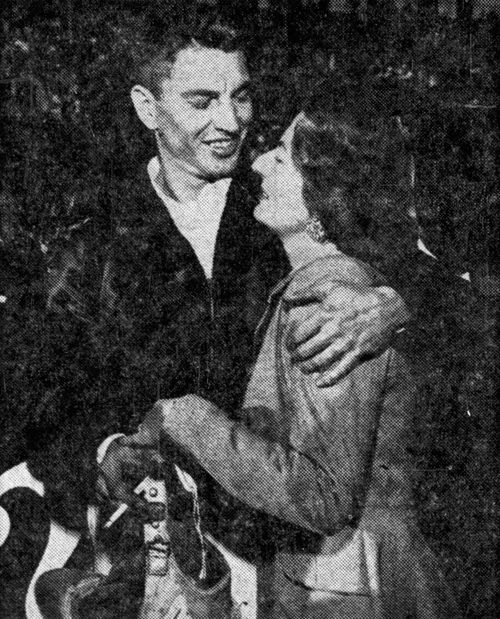
Bobby Grim receives congratulations from his wife Betty after he won the IMCA big car feature event at the Louisiana State Fair. – Bob Dial Photo


Shreveport, La. (October 31, 1954) – Bobby Grim took charge of things Sunday afternoon at the International Motor Contest Association big car auto races at the Louisiana State Fair. The “Hoosier Bombshell” pushed his powerful Honore Offenhauser to victories in the third heat and 20-lap feature and shattered the IMCA world’s record and a Shreveport track record.

The feature race was a red-hot duel between Grim and Jud Larson of Austin, Tex., with Larson chasing the speeding Hoosier right down to the wire. Grim turned the 20 circuits in 7 minutes and 10.29 seconds, to set a new IMCA world mark and wiping out the old standard of 8 minutes and 32.63 seconds set by Deb Snyder in St. Paul, Minn., in 1952. The record for the State Fair oval was 8 minutes and 37.07 seconds set last year by Vito Calia.

Grim also fashioned a new track record in the third heat, winning the 6-lap race in a thriller over Herschel Wagner of Hickman Hills, Mo., in the time of 2 minutes and 37.10 seconds, to beat the old record of 2 minutes and 40.87 seconds set in 1953 by Jim McWithey.

Jimmy Campbell of Bates City, Mo., opened the program by winning the first heat in a race which saw both Grim and Wagner spin out. Larson outran Bob Slater of Kansas City to capture the second heat. Larson also won the 4-lap handicap, beating Bob Cleburg of Rio, Wis., to the wire by a car length.

About 6,500 jammed the stands for the races.


Results –


1. Bobby Grim, Indianapolis
2. Jud Larson, Austin, Tex.
3. Jimmy Campbell, Bates City, Mo.
4. Bob Slater, Kansas Cit
5. Herschel Wagner, Hickman Hills, Mo.
6. Don Branson, Champaign, Ill.
7. Marvin Pifer, Adrian, Mich.
8. Curley Wadsworth, Topeka, Kan.
9. Harry Ross, Dallas, Tex.
10.Lee Drollinger, Champaign, Ill.


Sunday, October 29, 2023

1967 – Long Grove Grind goes to Adamson


Bobbie Adamson accepts his trophy after winning the National Open at Williams Grove Speedway. 


Mechanicsburg, Penn. (October 29, 1967) - There was never a dull moment for Bobbie Adamson as the Coraopolis, Penn., chauffer drove to victory in the fifth annual National Open before more than 10,000 fans at Williams Grove Speedway Sunday afternoon.

By virtue of his triumph, Adamson became the fifth different driver to win the event, joining Gordon Johncock, Larry Dickson, Lou Blaney and Henry Jacoby.

For the popular young winner, it was the first major triumph of his career. Only last week he had indicated that he desired a $999 win purse rather than the $1,000 which had been posted in hopes that it might change his luck. As it turned out, he didn't need this good fortune.

Adamson had qualified for the fourth starting spot in the 35-car field in Saturday’s time trials. He moved up one spot when the number two man Andy Phillips could not go in the main attraction after blowing his engine In warmups

When the green flag dropped on the field, Kenny Weld, the polesitter, charged ahead but going up the backstretch, Adamson pushed the Hawthorne Special out in front to a lead which he never gave up despite some real pressure throughout the affair. During the first six laps, Adamson opened a 10-length lead.

Then, the first of eight minor mishaps slowed the proceedings, closing up the field. At this time, Weld was running second. This is the way matters stood until the 42nd lap. Coming down the front chute, Bud Cochran slipped by Weld and took over the runner-up spot. From that point, Cochran was never more than five or six lengths behind the leader.

The two pacesetters battled it out for the remainder of the race. On the 84th circuit, Cochran pulled alongside Adamson moving through the third and fourth turns but did not have enough to push ahead. Three laps later, the two were bumper to bumper and stayed that way from then until the 92nd lap when Adamson opened daylight after slipping through lapped traffic.

As the race neared the wire, Cochran again closed on his worthy opponent, but Adamson would not be denied. He simply put his foot into it and remained at the head of the class. When Ray Dovel was involved in a mishap on the 99th lap, the yellow and checkered came out simultaneously, giving the win to Adamson but only by a scant two car lengths.

In third, eight lengths off the pace, was Ted Wise. Bobby Allen, Hanover, Penn., was fourth and Weld fifth.

Saturday, Weld recorded the best showing in the time trials with a clocking of 25.11 seconds for one lap on the half-mile track.


Results –


1. Bobby Adamson
2. Bud Cochran
3. Ted Wise
4. Bobby Allen
5. Ken Weld
6. Frank Gorichky
7. Larry Snellbaker
8. Steve Ungar
9. Dick Tobias
10.Ronnie Rough
11.Mitch Smith
12.Ed Zirkle
13.Bob Gerhart
14.Lynn Paxton
15.Joe Lingle
16.Milford Wales
17.Ray Dovel
18.Larry Cannon
19.Bill Banick
20.Johnny Crawford
21.Gene Varner
22.Ray Tilley
23.George Weaver
24.Bob Weaver
25.Dick Swartzlander
26.Gene Kohr
27.Hal McGilton
28.Rick Schmeylun
29.Bud Crytier
30.Gus Linder


Saturday, October 28, 2023

1973 – Anderson, Darkness Win in Salem’s ‘Midwest 300’


John Anderson receives the traditional winner’s kiss after winning the shortened Midwest 300 at Salem Speedway. – Brian Norton Collection


Salem, Ind. (October28, 1973) – Last year, the American Speed Association-sanctioned Midwest 300 stock car race became the Midwest 279 when a massive wreck forced one 100-lap qualifying race to be stopped on the 99th circuit and darkness halted the championship 100 after 80 laps.

Sunday, the second annual event became the Midwest 250.

With darkness about to envelop the Salem Speedway, John Anderson of Detroit, who had driven his 1973 Camaro to victory in the first 100 lap race, took the checkered flag on the 50th of a scheduled 100 laps in the championship race. He walked off with $2,250 in prize money.

In a fender-banging duel for second place, Ed Vanderlaan of Grand rapids, Mich., edged Bobby Watson of Prestonsburg, Ky. Vanderlaan collected $1,085 while Watson received $890. Terry Bivins of Shawnee, Kan., who won the second 100-lap qualifier, finished fourth in the championship finale.

Anderson, the 1973 track champion at Mt. Clemens (Mich.) Speedway, started ninth in the first 100-lapper but quickly moved though the pack to take the lead from Dave Dayton of Indianapolis on the 23rd circuit.

On lap 60, Bill Chambers of Cincinnati and James Hamm of Nashville collided in the second turn and ripped out 110 feet of guardrail. Hamm’s car scaled a tree, bent down the trunk and ended up nestled in the tree’s branches some 15 feet of the ground. Hamm suffered a broken ankle while Chambers escaped uninjured.

The race was stopped for 1 hour and 10 minutes while the guardrail was replaced. On the restart, fast qualifier Dave Wall of Shawnee Mission, Kan., who was running second at the time, spun coming off the fourth turn and triggered a 14-car smashup that delayed the race another 25 minutes.

Following the second restart, Anderson drove on to an uncontested victory.

In the second 100-lapper, Bivins jumped from his third starting position to take the lead from Jim Cushman of Columbus, Ohio, on lap 4. The race continued uneventful for the next 93 laps.

Then Larry Cope of Leroy Ind., brushed a car driven by Ed Angle of Flora, Ind., and vaulted over the turn four guardrail. The car came to rest upright outside the track and Cope was uninjured.

As the field came down the straightway to take the green flag to start the championship race, Anderson car, which was on the inside of the front row, skidded sideways. He regained control in time from wrecking, but the 12 cars piled up behind him, eliminating angle and Neal Sceva of Urbana, Ohio, before the race officially began.

Anderson was allowed to restart from his pole position and was never headed as he finished 3.5-seconds ahead of Vanderlaan and Watson before 5,150 race fans.


Results –


1. John Anderson
2. Ed Vanderlaan
3. Bobby Watson
4. Terry Bivins
5. Dave Watson
6. Dan Conner
7. John Vallo
8. Vern Schrock
9. Charlie Binkley
10.Mike Johnson
11.Mike Eddy
12.Ken Simpson
13.Denny Miles
14.Wayne Carden
15.John Sommerville
16.LaMarr Marshall
17.Ned Webb
18.Jim Hines
19.Joe Wallace
20.Ray Fullen
21.Dennis Wiser
22.Dave Dayton
23.Wayne Watercutter
24.Joe Ruttman
25.Ed Angle
26.Neal Sceva
27.Larry Cope
28.Bobby Sage
29.Charlie Glotzbach